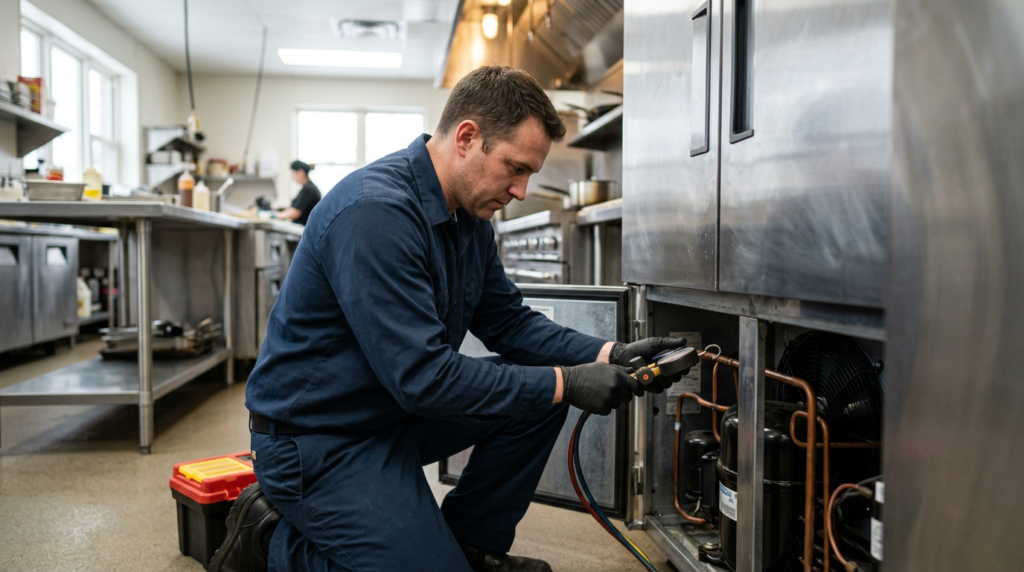
Quick answer: Call a commercial HVAC/R service company that can respond quickly, diagnose refrigerant and electrical issues safely, and handle food-safety documentation. Look for technicians who work on your specific equipment type (walk-ins, reach-ins, ice machines, prep tables) and can verify temperatures after repairs. If product is at risk, request triage steps over the phone and an on-site visit the same day when possible.
What to Expect From a Commercial Refrigeration Repair Visit
A proper service call starts with triage: what’s the box temperature, what’s the setpoint, and is the unit running constantly, short-cycling, or silent. A tech should check airflow first (dirty condenser coils, blocked evaporator, failed fan motors), then move to controls and refrigeration mechanics (thermostat/controls, contactors, capacitors, defrost system, refrigerant pressures, and signs of restrictions or leaks). That order matters because many “refrigerant problems” are actually airflow or defrost issues.
If you’re searching for Sun Prairie commercial refrigeration repair, ask whether the company services your exact equipment and refrigerant type, and whether they carry common parts for your brand. Many repairs hinge on getting the right fan motor, defrost timer/board, door gasket, or temperature probe quickly.
Before the tech leaves, you should expect a temperature check and a quick explanation of what failed, what was replaced or adjusted, and what to watch over the next 24 hours. For food operations, it’s also reasonable to ask for notes you can keep with your HACCP or temperature logs.
Signs It’s an Emergency (and What You Can Do While Waiting)
Some failures can’t wait until tomorrow. If you see temperatures rising fast, hear unusual grinding or squealing, smell electrical burning, or notice the compressor repeatedly clicking on and off, treat it as urgent. Ice buildup on the evaporator, water pooling inside a walk-in, or a condenser that’s too hot to touch can also signal a problem that will worsen quickly.
While you’re waiting, protect product and avoid making the damage worse. Keep doors closed, move high-risk items to another working unit, and clear airflow around the condenser (don’t stack boxes against it). If the unit is iced over, don’t chip ice with tools; that can puncture coils. If you suspect an electrical issue (burning smell, tripped breaker that won’t hold), leave it off and tell the technician what you observed.
Calling with clear details helps speed diagnosis: current temp, last time it held temp, whether fans are running, and whether the condenser coil is visibly dirty. Photos of the model/serial plate and the control display can save time, too.
How to Choose the Right Repair Company for Your Equipment
Commercial refrigeration is a mix of electrical, controls, airflow, and sealed-system work, so the best fit is a provider that routinely services restaurant and retail equipment, not only home HVAC. Ask if they work on walk-ins/coolers/freezers, reach-ins, prep tables, and ice machines, and whether they can handle both mechanical repairs and controls troubleshooting.
Also ask how they handle after-hours calls and what their typical response window looks like for emergencies. A typical range for diagnosis is 30–90 minutes on-site, but parts availability can drive the total timeline. Good communication matters: you want a clear explanation of options (repair now vs. temporary stabilization vs. replacement planning) and any operational changes that can prevent repeat failures, like coil-cleaning intervals or door-closer adjustments.
If you need help coordinating a repair and getting your system stable again, Nextech is a local option to contact for commercial refrigeration service in Sun Prairie.